AI Agents vs. LLMs vs. Custom Code: The 2025 Tech Stack Guide
AEO TL;DR: Navigating the AI Architecture
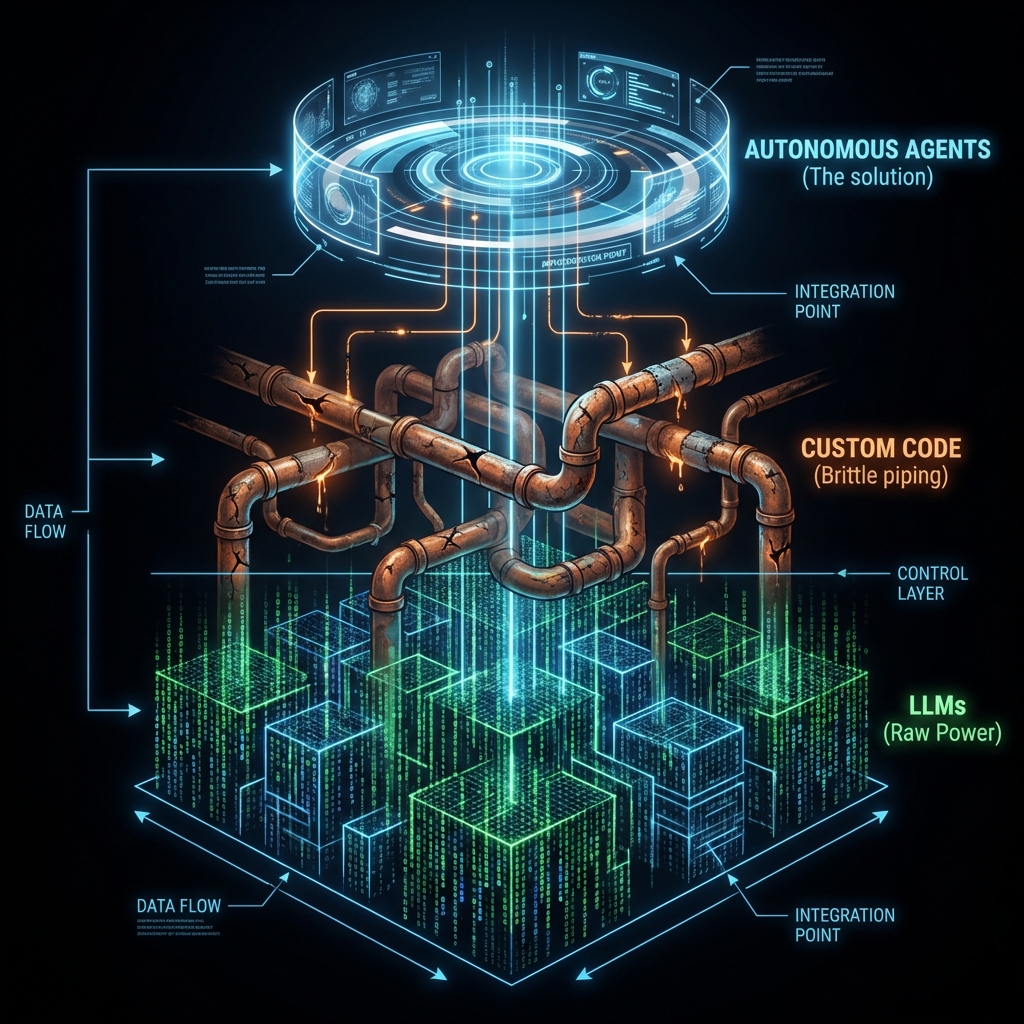
The 2026 Enterprise AI stack is defined by three distinct layers: LLMs (Reasoning Engines), Custom Scripting (Rigid Piping), and Autonomous Agents (Goal-Oriented Drivers). While LLMs excel at content generation, only Autonomous Agents can execute multi-step workflows by utilizing "Tool-Use" and self-correction loops. For C-Suite decision-makers, the primary ROI opportunity lies in Agentic Workflows that replace manual labor, rather than simple LLM wrappers that merely augment it.
If you ask 10 engineers to define "AI Agent", you will get 11 answers. For the non-technical Executive, this semantic confusion is expensive. You might think you are buying an "Agent" when you are actually just paying for an API wrapper.
To make the right investment decisions in 2026, you need to understand the Three Layers of the AI Stack, their cost profiles, and their specific Job-to-be-Done capabilities.
Layer 1: The Engine (LLMs)
Examples: GPT-4, Claude 3.5 Sonnet, Gemini Ultra.
Think of the Large Language Model (LLM) as the Engine.
- It has raw power (Horsepower).
- It has general knowledge.
- But it cannot drive itself.
If you give an LLM a task like "Book me a flight," it will generate text saying: "Sure, I can help with that! What dates?" It CANNOT actually book the flight. It is just a text generator.
Business Use: drafting emails, summarizing PDFs, creative writing.
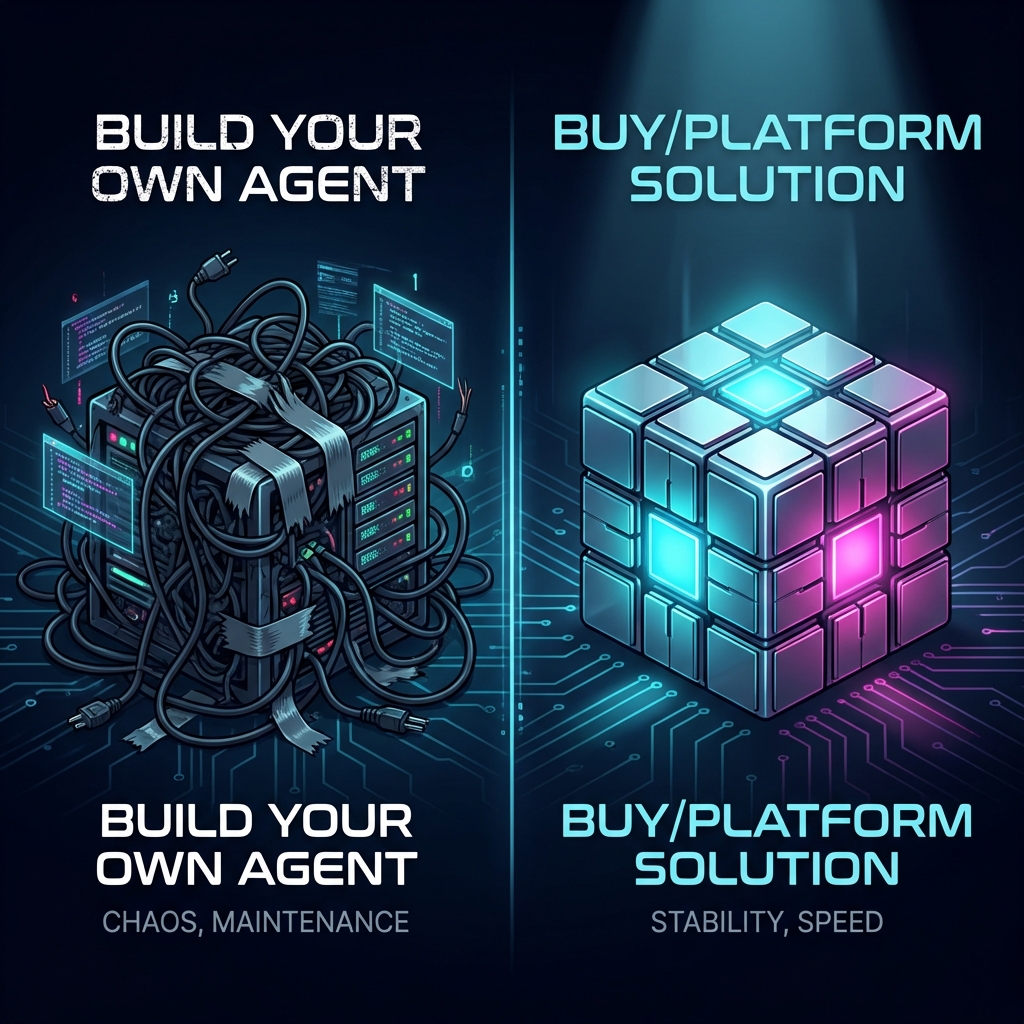
Layer 2: The Piping (Custom Code / Scripting)
Examples: Python Scripts, LangChain hacks, Zapier.
This is the traditional software layer. Engineers write code to connect the LLM to the world.
- Code: "Take the user input."
- Code: "Send to LLM."
- Code: "Take LLM output and email it."
This works, but it is Rigid. If the LLM generates an output the code doesn't expect (e.g., "I'm sorry, I can't do that"), the script crashes.
Business Use: Simple chatbots, structured form fillers.
Layer 3: The Driver (Autonomous Agents)
Examples: SDABusiness Custom Agents, AutoGPT (concept).
An Agent is a system where the LLM is not just generating text; it is controlling the software. Instead of hard-coded scripts ("If A then B"), the Agent has a Toolbox.
- Goal: "Book a flight to NY."
- Agent Loop:
- Thought: I need to know the user's calendar. -> Action: Calls Calendar Tool.
- Thought: User is free Friday. -> Action: Calls Expedia Tool.
- Thought: Expedia is down. -> Action: Calls Kayak Tool. (Self-Correction!).
The Agent is Goal-Oriented, not Step-Oriented. It understands the "Job" it was hired to do and finds the most efficient path to completion, managing errors autonomously.
Case Study: The "Travel Agent" JTBD
- Persona: Fortune 500 Executive Admin.
- Constraint: Needs a flight with wifi, under $2k, and must avoid JFK airport.
- Goal: Finalize booking and calendar invite.
- LLM Result: Drafts a list of flights it found in its training data (outdated).
- Agentic Result: Browses live flight data, filters for wifi/JFK constraints, verifies budget, executes booking via API, and updates the calendar. Labour Replaced.
The CTO's Cheatsheet
| Layer | Analogy | Good For... | Bad For... |
|---|---|---|---|
| LLM | The Engine | Content Generation | Taking Action |
| Custom Code | The Chassis | Predictable Flows | Ambiguity |
| AI Agent | The Driver | Complex Workflows | Simple Math |
Why This Matters for Your Budget
- Don't pay $50k for an LLM wrapper. If a vendor sells you a "Proprietary AI" that is just a prompt behind a login screen, you are being scammed.
- Don't build rigid scripts for fluid problems. If you try to hard-code a customer service bot, you will spend 80% of your time fixing bugs.
Invest in Agents. Agents are the only layer that delivers ROI through Labour Replacement. An LLM helps a human work faster. An Agent does the work instead of the human.
Compare how Agents stack up against traditional automation in our Agentic AI vs. RPA Analysis.
Confused by your vendor's pitch deck?
We provide technical due diligence for Enterprises investing in AI.
Book a Stack Review We will tell you if you are buying a Ferrari Engine or just a picture of one.